


By John Markquart
This past summer while the news outlets were busy covering the troubled children of Central America making the dangerous trek to America, a contingent of locals travelled to Honduras to experience NPH in Honduras, an orphanage that cares for nearly 400 kids. John, Terri, Charlee, Malia, Leah and Will Markquart were part of that group and were excited to see the amazing work of NPH on behalf of orphan and disadvantaged children of Honduras.
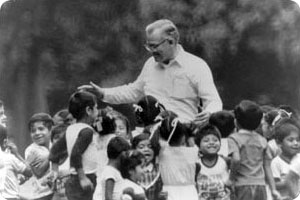 NPH stands for Nuestros Pequenos Hermanos which is Spanish for Our Little Brothers and Sisters. NPH has nine facilities in Latin America including an orphanage located on a 2000 acre ranch in central Honduras. The organization was founded by Father Wasson in Mexico in the 1950’s when he decided to take in an orphan boy caught stealing from the church’s poor box. He soon had 8 more and NPH had its mission.
The model for helping kids at NPH is remarkably different than most other orphanages and, in my experience, remarkably effective. NPH does not seek to place their children in families through adoption. Instead, they seek for the ranch and all the people there to become one very large family for each other. Their philosophy centers around the principles of love, security, sharing, work, responsibility and faith. We saw firsthand how the staff, volunteers and children join together and form a community that provides a genuine feeling of family for most everyone there!
Our trip was organized by local surgeon Nino Parise and his wife Dana who have dedicated much of their lives to supporting and promoting the work of NPH in Honduras. Our group consisted of 25 people, primarily from the Eau Claire area, who hoped to leave their imprint on the people Honduras. Instead it was the people of Honduras who left their mark on us. From Edwin to Aldo and Carlos, to Marisol and Jessica, each of us came to know some amazing children. Each child has a story which would be painful to hear, yet so many of the children here have a genuine radiance about them which is absolutely miraculous given the hardship they have likely endured.
Our group’s morning at the ranch was spent helping with chores on the ranch like weeding the garden, collecting eggs from the chicken coop, preparing meals, or helping kids with their English. Afternoons were spent hanging out with the kids, relaxing, playing some soccer, and in a devotional led by the Dana and Nino. In the evening we split up and ate dinner in the children’s homes which are called Hogar (pr. O Gar), which means dormitory in Spanish. Each Hogar was staffed by adults that supervised the kids that lived there.
At the ranch the children went to school and learned how to work. It was new to us to see children at a young age learning the manual labor which is still a mainstay in the Honduran economy. Kids would wash their own clothes and dishes, and spend part of each day on chores like working the garden, cutting the grass with a machete, or moving material in a wheelbarrow. It seems like a lot of responsibility for such young children and yet it is necessary to prepare them for their lives ahead. As the children get older many are taught a trade like woodworking, welding, sewing, auto repair or making shoes. Whether kids will continue with upper education or go into the workforce, the goal at NPH is to help them prepare.
There is far more to the lives of the kids than just school and chores. They love hanging with the other kids, playing soccer and having fun. Everywhere we looked kids were being kids, laughing, rough housing and running around. Many people in our group commented on how happy that most of the kids seemed to be at the ranch.
There were many touching stories that we experienced at NPH. Dana and Nino told us about trying to explain to the children about their daughter who was adopted from an orphanage in Ethiopia. One of the kids asked “What’s an orphanage?” Obviously an ironic question for a kid living at an orphanage. It struck me that perhaps NPH just doesn’t feel like an orphanage to these kids. My wife Terri asked a 12 year old boy new to the ranch how he liked it. He said “He liked it. No one beats him here.” Anyone care to guess who we will sponsor?
As our TV screens are filled with images of desperate young people fleeing their troubled lives in Mexico and Central America it seems like there is nothing we can do living so far away in Wisconsin. Perhaps supporting organizations like NPH is something tangible that you can do to really make a difference in the lives of troubled kids. I was fortunate to experience their blessing first hand. If you are interested in learning more, or want to sponsor one of the kids at the ranch, go to www.nph-honduras.org for more information.
![[Facebook]](https://www.markquarttoyota.com/blogs/324/wp-content/plugins/bookmarkify/facebook.png)
![[LinkedIn]](https://www.markquarttoyota.com/blogs/324/wp-content/plugins/bookmarkify/linkedin.png)
![[Twitter]](https://www.markquarttoyota.com/blogs/324/wp-content/plugins/bookmarkify/twitter.png)
![[Yahoo!]](https://www.markquarttoyota.com/blogs/324/wp-content/plugins/bookmarkify/yahoo.png)
![[Email]](https://www.markquarttoyota.com/blogs/324/wp-content/plugins/bookmarkify/email.png)
Connect with us


